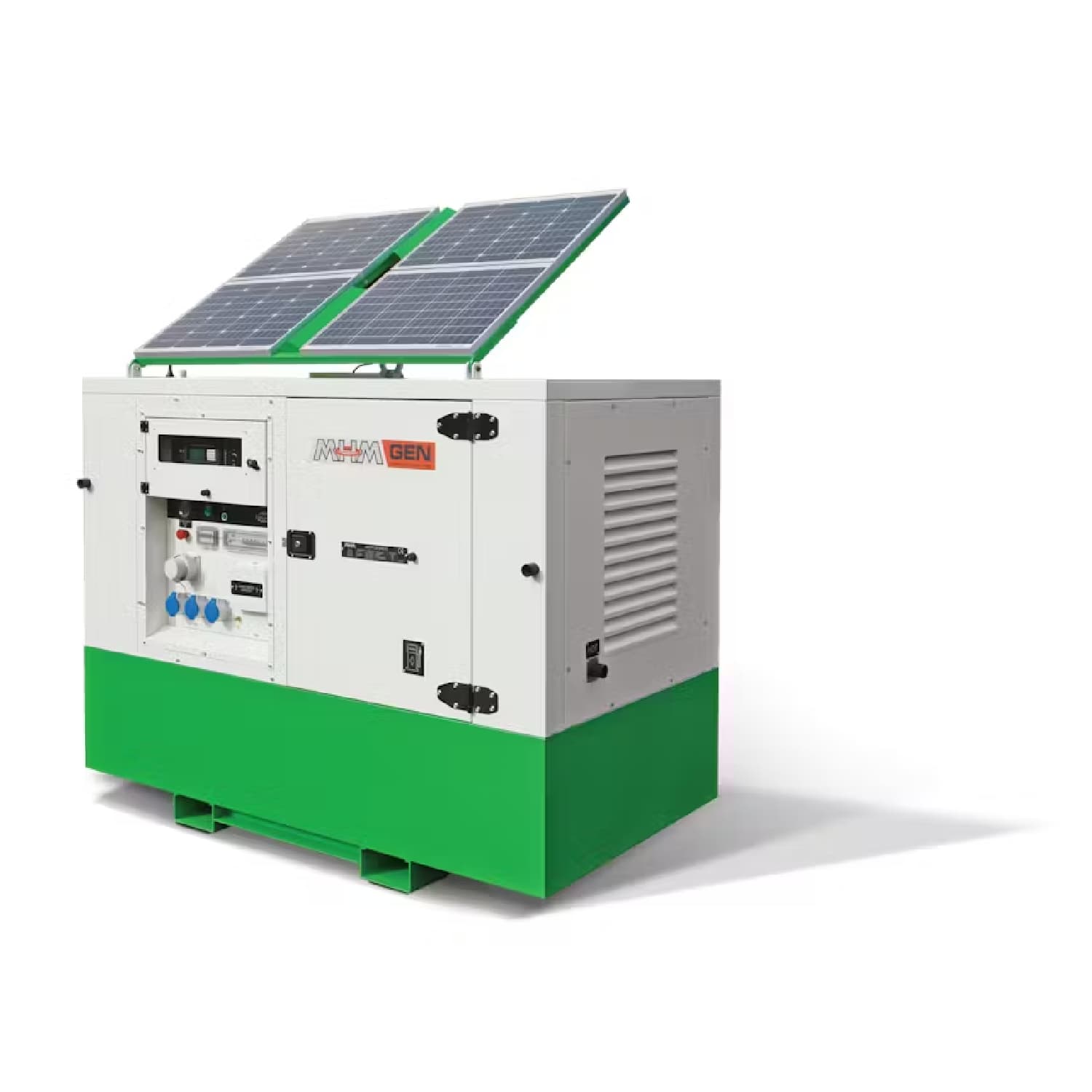
Images are for illustration purposes only. Actual product may vary.
10kVA Solar Hybrid Generator hire
No account neededSecure checkoutLargest hire network
Everything you need to know about 10kVA Solar Hybrid Generator hire
Description
10kVA Solar Hybrid Generator Hire Alternative Power Solution 10kVA solar hybrid generator hire provides an efficient power supply when there is no access to mains. They are ideal for low and variable temporary power applications over long periods of time, and you can use they to power equipment like lights, heaters, welfare units, tools, and more on construction sites, festivals, marquees, public events, and other temporary structures. You can also use them for emergency power when there is an outage. Hybrid generators use different sources to produce energy. They use solar power, fuel, and also have charging batteries that store energy. The exchange is automatic, so you do not need to monitor the system, offering extra reliability when you are working with critical systems that you must power at all times. The roof mounted high-efficiency solar panels are fully adjustable, allowing you to make the most of daylight hours to support and maintain the robust, durable, long-lasting internal lithium batteries in all weather conditions. The stage 5 engine is also HVO (Hydrotreated Vegetable Oil) fuel approved, so you can run it on HVO, diesel, or even a mixture. These units reduce your CO2 emissions, fuel consumption, and noise pollution. You can use them in sensitive areas and during the night when loud sounds can be more disruptive. They are also designed for user safety, with an engine protection shutdown system, variable RCD, emergency stop, fully bunded base, internal bund alarm, all helping to prevent incidents and spilt fluids. Socket Configuration 3ph (400V)1ph (230V)1ph (110V) 63A 32A 32A 16A 32A 16A Output Input Output Input Output Input Output Input - - 1 1 2 - - -
Click here to view all the distribution boards, cables, fuel tanks, battery storage, cables and more
Specification
Max. Generator Output: 10kVA/8kW Voltage: 230V – 1ph Battery Storage: 7.7kWh – 4 x 230 Ah/12V DC Battery Type: Lithium Insulation Class: H Mechanical Protection - IP: 23 Engine Mode/ Battery Mode Switch Over: Over 2000W Load = Engine Only, Under 2000W Load = Battery Only Noise Level - Generator Mode: LWA=87 dBa@7m=62 Noise Level - Battery Mode: >= 0 Roof Mounted Solar Panel: 215W Make: Kohler Type: TBA (Stage 5) Fuel: Diesel / HVO (HVO = BS EN 15940:2016 Only) Number of Cylinders: 3 Power – HP: 14 Engine Speed – RPM: 1500 Cooling: Water Fuel Consumption @ 75% Load (Litres/hour): 1.8 Fuel Tank Capacity (Litres): 200 Diesel Generator Runtime 'Constant Load'@ 75% (Hrs): 111 Battery Only Run Time ""Constant Load"" (Hours): 1900W: 3.5, 1200W: 6.5, 600W: 14, 400W: 19 CO2 Per Hour @ 75% Load: 4.7kg Battery Recharge Time (Hrs): Empty to Full = 14Hrs Starting System: Deepsea 3110 Length: 1730mm Width: 1080mm Height - Solar Panel Down: 1520mm Dry Weight (No Fuel): 1050kg Wet Weight (Fuel Full): 1210kg
Features
Which solar hybrid generator is right for you?
Solar Hybrid Generator FAQs
What size generator do I need?
How to Calculate What Size Generator You Need
Working out the right generator size comes down to three things: what equipment you need to run, how much power each item uses, and whether anything has a high starting current that temporarily spikes the load.
Step 1: List Everything You Need to Power
Write down every piece of equipment or appliance you want the generator to run at the same time. Be realistic here — you probably don't need to run every single thing simultaneously. Focus on the essentials that must stay on during a power outage or that you need on site at any given moment.
Step 2: Add Up the Running Watts (or kW)
Every electrical device has a wattage rating, usually on a label or in the manual. Add up the running wattage of everything on your list. This gives you your continuous load in watts or kilowatts.
Step 3: Convert Watts to kVA
Generators are rated in kVA (kilovolt-amperes), not kW (kilowatts). The difference is power factor. For most diesel generators the power factor is 0.8, which means:
kVA = kW ÷ 0.8
So if your total running load is 8 kW, you need a minimum of 10 kVA. Simple as that.
What is the difference between kVA and kW on a generator?
kVA is apparent power and kW is real power, and the gap between them is the power factor. Most diesel generating sets are rated at 0.8 power factor, so a 100 kVA set delivers around 80 kW of usable power. Manufacturers quote generators in kVA and equipment is usually quoted in kW, which is where most undersizing errors start.
What is the difference between standby, prime and continuous rating?
The rating tells you how long the set can run and how much overload it will accept. Standby (ESP) is for mains failure only, with limited annual running hours and no overload capability. Prime (PRP) is for extended running on a variable load. Continuous (COP) is for constant load and unlimited hours, typically off-grid or export applications. Running a standby-rated set as a prime power source will shorten its life and can invalidate the warranty.
What is the difference between Three phase and Single-Phase Generators?
Single phase power
Single phase power is generated using a single AC wave and typically has a voltage range of 220 to 250V (or 110 to 120V on a dual voltage generator). Generators designed for single phase power feature sockets with three cables: Live, Neutral, and Earth. These generators are generally small, with a capacity of up to approximately 10kW, although some single-phase generators can reach 40-50kW. They are used primarily for powering small appliances in both residential and commercial settings, or for supplying electricity to small properties.
Three phase power
In contrast, three phase power is generated using three AC waves and typically operates at a voltage range of 380 to 440V. Generators designed for three phase power have sockets with five cables: 3 x Live, Neutral, and Earth. These generators are typically larger, with capacities above 10kW, although some models are available from around 5kW. Three phase generators are mainly used to power larger appliances, especially in commercial settings, or to supply electricity to larger properties, whether residential or commercial. In some cases, even if the appliances inside a building are single phase, a three phase generator may still be necessary for larger structures such as warehouses or factories.
It is important to note that while it is possible to draw single phase power from a three phase generator, doing so would only provide 1/3 of the total power capacity. However, this is not recommended as a long-term solution due to the potential phase imbalance it can cause on the generator.
Single Phase Power:
- Produced through a single AC wave
- Voltage range of 220-250V (or 110-120V on a dual voltage generator)
- Generators have sockets with 3 cables: Live, Neutral, and Earth
- Typically small, up to around 10kW (some can go up to 40-50kW)
- Used for powering small appliances in domestic and commercial settings, or for small properties
Three Phase Power:
- Produced with three AC waves
- Voltage range of 380-440V
- Generators have sockets with 5 cables: 3 x Live, Neutral, and Earth
- Usually larger, above 10kW (some available from around 5kW)
- Mainly used for powering larger appliances in commercial settings or larger properties
- Three phase generator may be required for larger buildings, even if appliances inside are single phase
I would like to connect a generator to my house in case of mains failure. What do I need to do?
When connecting a generator to a house or building for either mains failure or direct supply, there a several key points that need to be observed.
1. Safeguarding Utility Workers: Isolating the Generator from the Mains Supply
It is vital that the generator is completely isolated from the mains supply. This ensures that it does not electrocute a utility worker trying to restore the mains supply. To achieve this, a double-pole, break-before-make, changeover switch must be installed by a qualified electrician. This should be fitted between the electricity meter and the building consumer unit. The switch connects the building to either the mains supply or to a lead which can be plugged into the generator.
2. Adapting the Generator Input: Configuring for RCD Compatibility
Most buildings now have an RCD built into the consumer unit. This is configured to operate from the mains supply with an earthed neutral, and not from a generator with a floating earth. To utilise this protection device, it is necessary to modify the generator input so that it is configured in the same way as the mains supply. This is a simple modification for a qualified electrician, involving adding a link wire from the neutral terminal to the earth terminal.
It is recommended to make this connection in the plug that is to be used to connect to the generator. This ensures that the generator is unmodified when it is disconnected from the house, and therefore remains safe. The plug should be labelled “Do not connect to mains: Neutral-Earth link fitted”. The lead between the generator and the transfer switch is not protected by the RCD, it is therefore recommended to use a steel armoured cable for this connection. A local low-impedance earth spike needs to be installed.
3. The Danger of Back Feeding: Never Plug the Generator into a Wall Socket
NEVER attempt to supply power to a building by connecting the generator to a wall socket, a hazardous practice known as back feeding. This poses an extremely dangerous risk of electrocution to utility workers and neighbors who share the same transformer. Moreover, there is a genuine danger of someone inadvertently disconnecting the live plug, leading to potentially fatal consequences. Additionally, this method bypasses built-in household circuit protection devices, further increasing the risks involved.
How noisy are generators and Which generator should I use for quietness?
Petrol frame generators can be quite noisy, Petrol inverter (Suitcase generators) are relatively quiet, diesel generators can be sound attenuated so that noise levels are reduced, however an open frame skid diesel generator can sometimes be noisy
Invertor generators, aka portable generators tend to be the quietest generators on the market, averaging between 50-70 dba. In order to determine which quiet generator is the most suitable for your application, you must firstly decide on the amount of power you require (you can use the table below to guide you). Once you have determined the appropriate wattage, you can then compare generators with the appropriate power output, against their dba to find the quietest generator for your
Have a question? Get in touch (opens in new tab) and we'll help.